Is there a Duolingo for history? The apps that come closest
Short answer
No: according to its US App Store listing (read October 20, 2026), Duolingo teaches 40+ languages, math, music and chess, but has no history course. The closest "Duolingo for history" is Aurelius: Learn History (our app, 9.2/10), because it copies all four parts of Duolingo's formula: short lessons, a quiz right after each, streaks and rewards, and a fixed path, which in history means 13 eras in chronological order from Ancient Egypt to the Cold War. Historo and Histopia copy most of the formula with courses, streaks and challenges; Paladin has 5-minute lessons with a quiz after each but no path through time. Aurelius costs $9.99 a month after a 3-day free trial; Histopia's lessons are free.
We make Aurelius, which we built as "Duolingo for history", so take our verdict as a declared interest and check the table yourself. Every fact below comes from the apps' own store listings, read October 20, 2026.
Does Duolingo have a history course?
No. Duolingo's App Store listing names its courses: 40+ languages (including Latin and High Valyrian), Math, Music and Chess. There is no history course. People searching "Duolingo for history" want the same experience for a different subject, which is what the apps below try to offer.
What makes Duolingo work
What a "Duolingo for history" needs
Short lessons
A few minutes, so starting is easy and you rarely skip a day.
Recall right away
A quiz straight after the lesson. Being tested on what you just read is one of the most reliable ways to remember it (Roediger & Karpicke, 2006).
A habit loop
Streaks, XP and rewards that bring you back tomorrow. Spreading learning over many short sessions beats cramming (Cepeda et al., 2006).
A fixed path
Unit 2 builds on unit 1. In a language that is grammar; in history it is time. Without it you collect facts that never connect.
History apps against the Duolingo formula
| App | Short lessons | Quiz after each lesson | Streaks and rewards | Fixed path in time order |
|---|---|---|---|---|
| Aurelius (our app) | Yes, a few minutes | Yes | Streaks, XP, 76 Honors, battles | Yes: 13 eras, lessons linked |
| Historo | Yes | Quizzes, not after each lesson | Streaks, XP, weekly challenges | Structured courses |
| Histopia | Yes | Quizzes | Streaks, XP, leaderboards | A learning path |
| Paladin | Yes, 5 minutes | Yes | Levels, collectible characters | No: built around people |
| Nibble | 10 minutes | Quizzes | Not stated | No |
| App | Score | Best for | App Store rating | Google Play rating | Price (US) | Platforms |
|---|---|---|---|---|---|---|
| Aurelius Our app | 9.2/10 | Learning world history in order, as connected stories, in 5 minutes a day | No ratings yet | No rating shown yet | 3-day free trial, then $9.99/month or $79.99/year | iPhone/iPad, Android |
| Historo | 6.4/10 | AI-generated lessons on any history topic you ask for | 4.5 from 4 ratings | 4.1 from 171 reviews | Historo+: $8.99 to $9.99/month; $34.99 to $59.99/year | iPhone/iPad, Android |
| Histopia | 6.3/10 | Free lessons with history minigames and collectible cards | 5.0 from 2 ratings | 4.2 from 11 reviews | Lessons free; optional Premium $9.99/month or $79.99/year | iPhone/iPad, Android |
| Paladin | 4.6/10 | Animated 5-minute stories about famous people | 4.6 from 23,623 ratings | 4.6 from 19,124 reviews | Pro: $12.99/month, $24.99 for 3 months; six yearly prices listed, $29.99 to $99.99 | iPhone/iPad, Android |
The closest: Aurelius
Aurelius was built as Duolingo's structure applied to history: a campaign map of 13 eras where each lesson leads to the next and ends with a quiz "with hearts on the line". You keep a daily streak, earn XP and Honors, and can battle friends on trivia. What it adds for history: every image is a credited painting, artefact or photo, and lessons explain causes and consequences. 3-day free trial, then $9.99 a month or $79.99 a year.
The free option: Histopia
Short lessons on a learning path, quizzes, streaks and leaderboards, plus ancient board games; Premium only adds extras. Less history coverage and no sources described. Histopia review.
The AI option: Historo
Courses, quizzes, streaks and weekly challenges in 12 languages, generated with AI. Historo review.
Make any app stick
- Same time every day, tied to something you already do.
- One era at a time. Finish Rome before you start the Renaissance.
- Take the quiz honestly, without scrolling back.
- Follow one source further each week: a book, a museum page, a documentary.
More in how to learn history, and check any app with our Timeline Test.
Frequently asked questions
Does Duolingo have a history course?
No. As of October 2026, Duolingo's listing names languages, math, music and chess, not history.
What is the closest app to Duolingo for history?
Aurelius, our app: short lessons in a fixed chronological path, a quiz after every lesson, streaks and rewards. Histopia and Historo come next.
Is there a free Duolingo for history?
Histopia is the closest free option: short lessons on a learning path, quizzes, streaks and leaderboards, with optional Premium.
Is a Duolingo-style app enough to learn history?
It builds the habit and the timeline. Then read further on the eras you like; the timeline gives every book a place to hook onto.
Does Duolingo teach Latin?
Yes, Latin is among Duolingo's language courses. It teaches the language, not Roman history.
The bottom line
Duolingo won't teach you history, but its formula can. Pick an app with all four parts: short lessons, a quiz after each, a reason to come back, and a path in time order. Try Aurelius free for 3 days, or start free with Histopia.
Sources
- Duolingo, US App Store listing, read October 20, 2026; history apps' listings, same date.
- Roediger, H. L., & Karpicke, J. D. (2006). Psychological Science, 17(3), 249–255. PubMed
- Cepeda, N. J., et al. (2006). Psychological Bulletin, 132(3), 354–380. PubMed
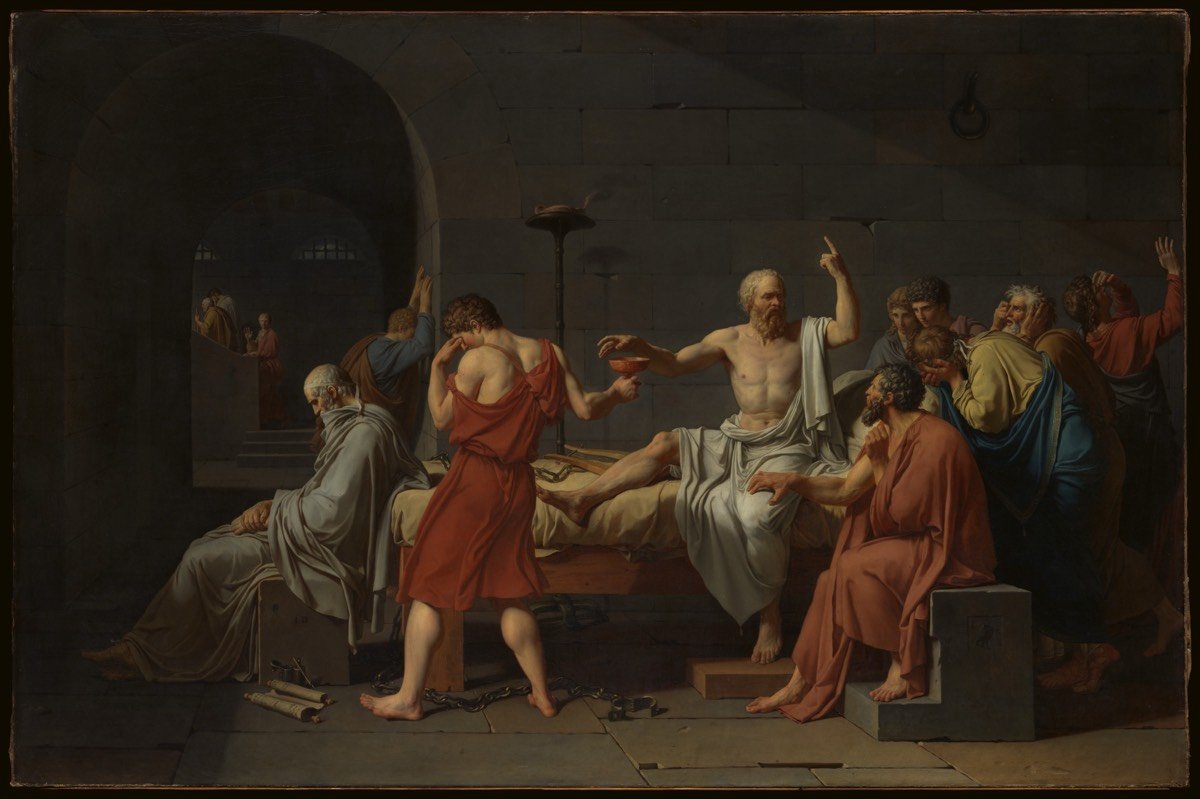
- Jacques Louis David, The Death of Socrates, 1787, The Metropolitan Museum of Art, Open Access (CC0).