How to learn history (and actually remember it)
Short answer
To learn history and remember it, go in chronological order, one era at a time; keep sessions short and daily; test yourself right after each lesson; and always ask why something happened. These steps rest on two of the best-supported findings in learning research: being tested on what you just read beats rereading it (Roediger & Karpicke, 2006), and spreading study over many short sessions beats cramming (Cepeda et al., 2006). Five minutes a day adds up to about 30 hours a year, enough for a first pass through world history from Ancient Egypt to the Cold War. You can follow the method with books, podcasts or free courses; an app built this way, such as Aurelius (our app: 13 eras, 127 lessons, a quiz after each), does the ordering and testing for you.
By Angelo Sorbello, founder of Aurelius. Like most people, I left school with a handful of dates and no idea how they fit together. This guide is the method we built Aurelius around, and it works with any app, book or podcast.
Why history doesn't stick
Most of us learned history as a list of dates for a test, out of order and without the story that connects them. Isolated facts fade within days. What sticks is a story with causes: Rome's Republic falls after the Gracchi, Marius and Caesar; the Black Death shakes the medieval order; the American Revolution helps inspire the French one. When each event is the consequence of the last, remembering one recalls the next.
Rereading feels like learning, but isn't
In a well-known experiment, students who reread a text felt more confident than students who were tested on it, yet remembered less a week later (Roediger & Karpicke, 2006). Highlighting and rereading feel productive; recalling from memory is what works.
Cramming fades fast
A review of 317 experiments found that spreading practice over time produces better long-term memory than massing it into one session (Cepeda et al., 2006). A 2013 review of ten study techniques rated only two as "high utility": practice testing and distributed practice (Association for Psychological Science).
The method: 5 minutes a day
The 5-minute method
- 1Pick the next lesson in orderNever jump between eras on the same day.
- 2Read for 4 minutesOne event, its cause and its consequence.
- 3Quiz yourself for 1 minuteFrom memory, without scrolling back.
- 4Say why in one sentence"This happened because…"
- 5Come back tomorrowSpacing beats one long session.
Step 1: Start at the beginning
Ancient Egypt, Greece, Rome, Medieval Europe, the Renaissance, the Age of Exploration, the revolutions, the industrial age, the World Wars, the Cold War. See the order to learn world history.
Step 2: One era at a time
Don't jump between WWII and the Aztecs on the same day. Finish an era, then move on: you are building a timeline, and each era needs the one before.
Step 3: Five minutes, every day
Pick a fixed moment you already have (coffee, commute, before bed). Five minutes every day beats an hour on Sunday, and it is small enough that you won't skip it.
Step 4: Test yourself straight after
Answer two or three questions from memory before moving on, without scrolling back. Getting one wrong is useful: it shows you what to look at again.
Step 5: Ask why
For every event, name one cause and one consequence in a single sentence: "this happened because…, and it led to…".
Step 6: Look at the evidence
A painting, a letter, a quote from someone who was there makes an event concrete. Note who made it and when; that is how historians think, and it makes the event memorable.
Step 7: Go deeper on what grabs you
When an era hooks you, read a book, find a podcast or visit a museum. Now it has a place on your timeline to hang on.
Tools that help
| Need | Tool |
|---|---|
| A daily lesson in order, with a quiz | Aurelius (our app) |
| A free full course | Khan Academy world history |
| Free lessons with games | Histopia |
| Reading in depth, for free | World History Encyclopedia |
| Revising for an exam | History Master |
| History where you live (US) | Clio |
To check any app in two minutes, use our five-question Timeline Test. All options compared: the best history apps.
Frequently asked questions
What is the best way to learn history?
Learn it in chronological order, one era at a time, in short daily sessions, and test yourself right after each one. Ask why each event happened, and look at evidence from the time. These habits match the two study techniques research rates most effective: practice testing and spacing.
How can I learn history fast?
You can't skip the order, but you can move fast through it: one short lesson a day in a fixed path covers world history in a few months. Focus on causes and consequences, not dates; dates are easier to remember once you know the story.
What order should I learn history in?
Chronological: from the ancient world (Egypt, Greece, Rome) to the Middle Ages, the Renaissance and exploration, the age of revolutions, the industrial age, the World Wars and the Cold War. See the 13-era timeline.
Can you learn history with an app?
Yes, if the app goes in order and tests you after each lesson. Apps that show random facts are entertaining but teach less. Check any app with the Timeline Test.
How do I get better at history?
Build a timeline first, then hang details on it. Read primary sources, quotes from people who were there, and explain each event in one sentence: "this happened because…".
How long does it take to learn world history?
A first pass through 13 eras at one 5-minute lesson a day takes a few months; Aurelius' 127 lessons take about four months at one a day. Real depth comes after, era by era.
Is it too late to learn history as an adult?
No. Adults have an advantage: you already know how the world works today, so causes and consequences make more sense than they did at school. See the best history apps for adults.
The bottom line
Order, a little every day, and a quiz right after: that is the whole method. You can do it with a library card. If you'd rather have it done for you in 5-minute lessons, try Aurelius free for 3 days.
Sources
- Roediger, H. L., & Karpicke, J. D. (2006). "Test-enhanced learning: Taking memory tests improves long-term retention." Psychological Science, 17(3), 249–255. PubMed
- Cepeda, N. J., Pashler, H., Vul, E., Wixted, J. T., & Rohrer, D. (2006). "Distributed practice in verbal recall tasks: A review and quantitative synthesis." Psychological Bulletin, 132(3), 354–380. PubMed
- Dunlosky, J., et al. (2013). "Improving students' learning with effective learning techniques." Psychological Science in the Public Interest, 14(1). Summary: Association for Psychological Science
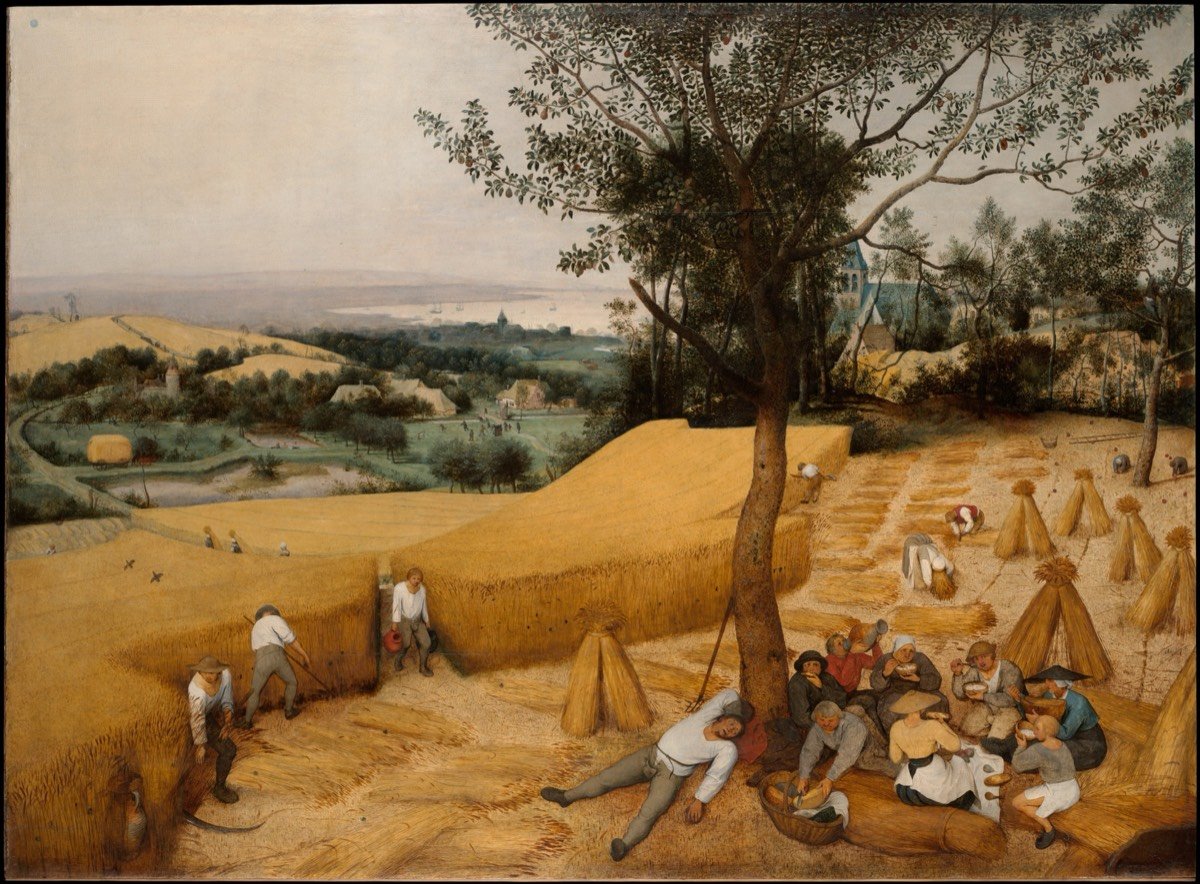
- Pieter Bruegel the Elder, The Harvesters, 1565, The Metropolitan Museum of Art, Open Access (CC0).